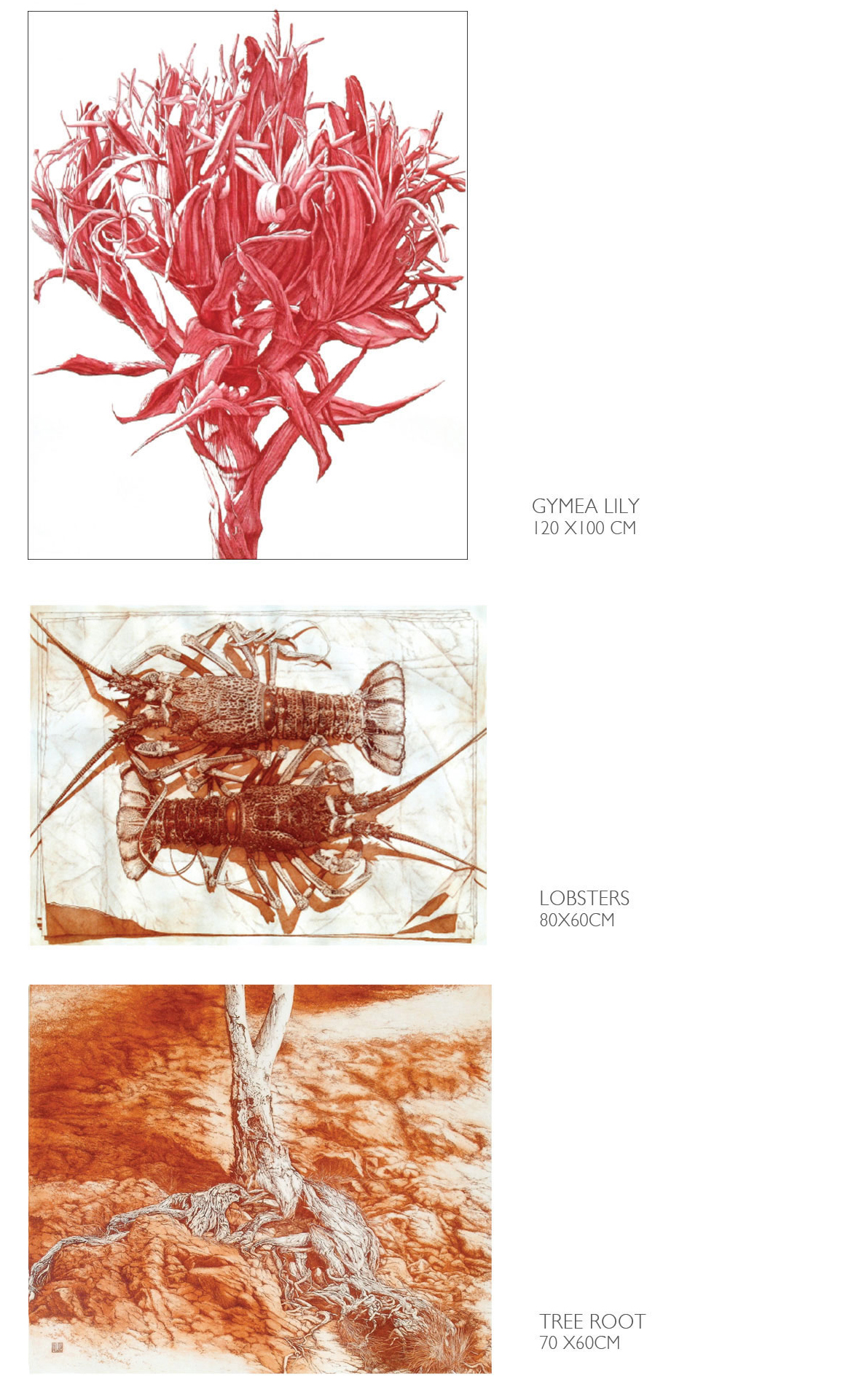
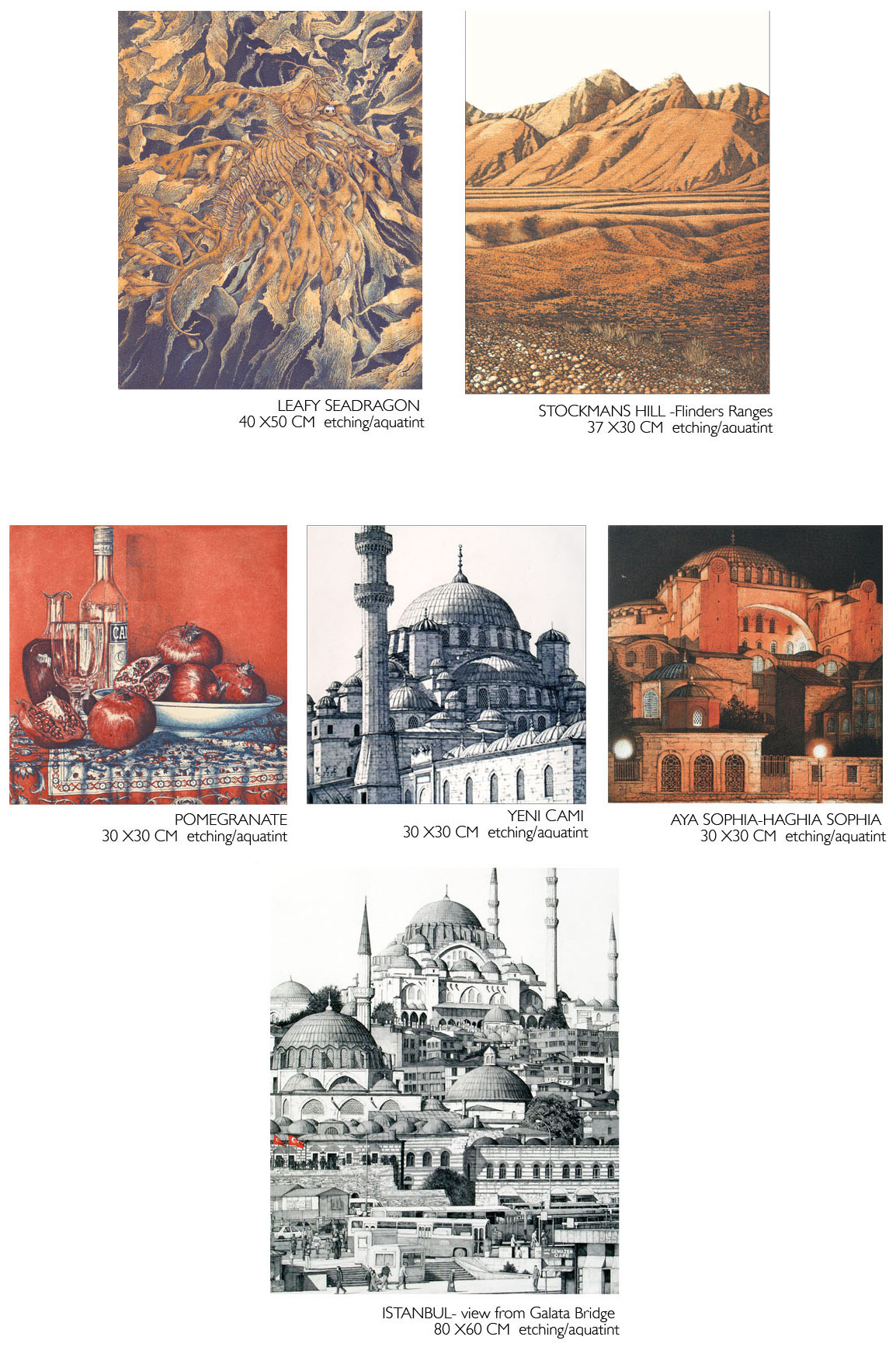
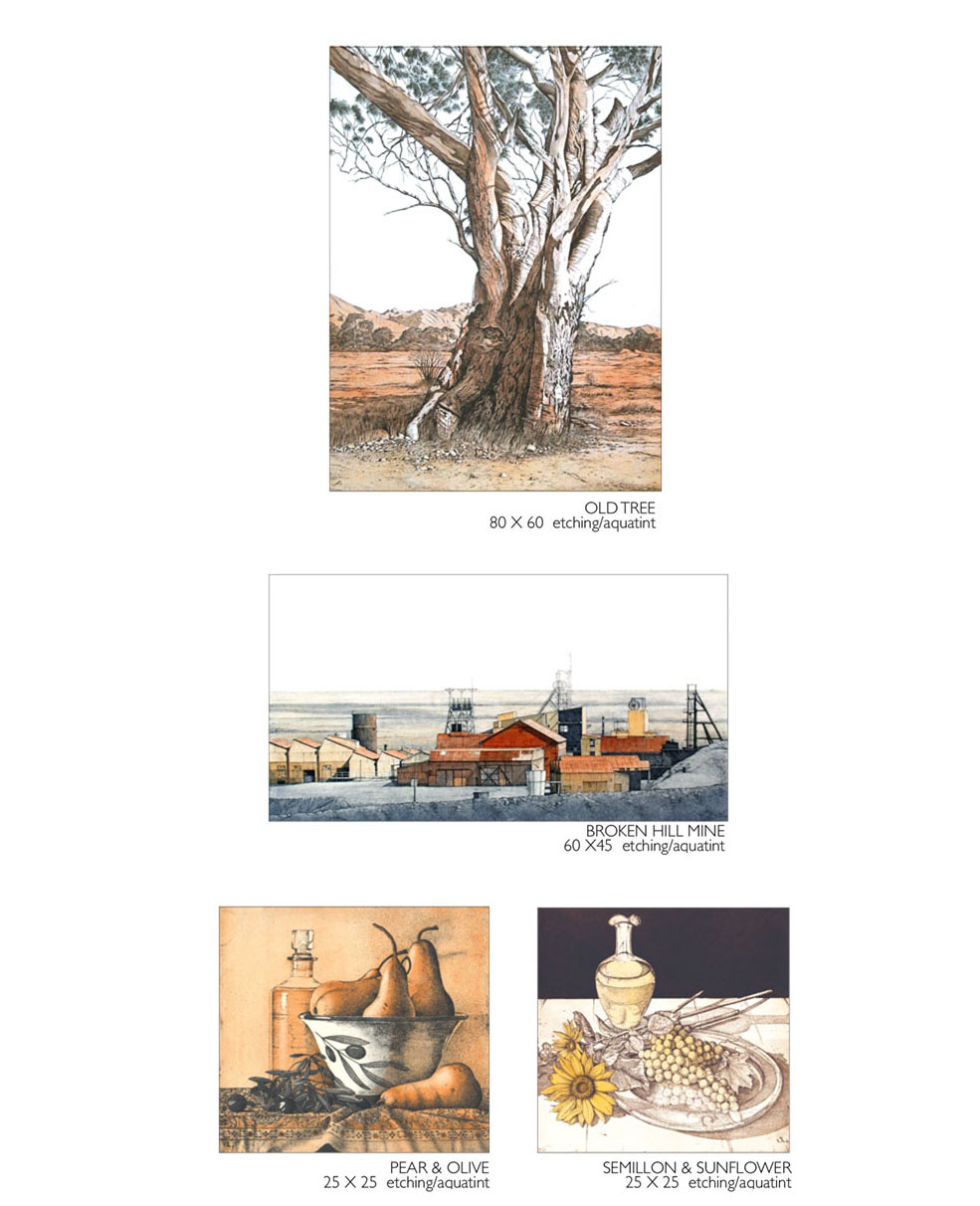
Etching in progress
First drawing on plate coated in hard ground.
INTAGLIO PRINTMAKING

Etching is one of several processes grouped under the category Intaglio that have in common the incision of lines or images into a surface, usually metal. Intaglio prints result when the incised areas are filled with ink or a similar substance for transfer of the image to paper. The vehicle for cutting into the metal or other material may be either a sharp tool (engraving, wood engraving, drypoint, mezzotint) or an acid solution (etching or aquatint). Once the plate has been cut, the depressed areas are filled with ink and the non printing surface wiped clean. Pressure applied by a printing press forces paper into the depressed areas, and the image is transferred.

The underlying principles of intaglio printing were known in the Middle Ages, especially to goldsmiths and armourers. It was not until the 15th century when paper became more generally available that intaglio printing emerged as a specific art.. The goldsmith and the armourer played an integral part in the culture of medieval Europe. These artisans needed to keep a record of their engraved designs, as well as to follow the development of work in progress, thus they transferred their images to paper.

Wood and metal engraving were the first developed of these processes and in the 15th century served two quite distinct purposes, serious religious imagery and popular secular themes. In a population that was overwhelmingly illiterate, prints depicting the saints, the mysteries and other holy scenes preformed as direct, cheap and portable methods of instruction. One of the most popular secular outlets for the engravers art was in the production of playing cards. The latter offered a major form of recreation for both the aristocracy and the common people.

Discovery of the technique of printing from acid etched plates seems to have occurred some time between 1510 and 1515 in both Italy and northern Europe. Its more flexible techniques opened the way for the rich and varied graphic production by painter-etchers of the sixteenth and seventeenth centuries. Printmaking passed from highly, and laboriously, trained engravers into the hands of painters, who were usually men of wider artistic ambition and vision.

Beyond doubt the consummate etcher of all time was Rembrandt. Thought he is best known as a painter Rembrandts massive oeuve includes more than three hundred plates, mainly etchings and drypoints. He was also an avid collector of other artists prints, often producing a similar image as a public demonstration of his superior creative skills.

Etching techniques have advanced over the last five centuries, better tools, inks, papers, metals and printing presses have made the creative process considerably easier for the artist and printmaker. But the processes would still be immediately recognizable to artists twenty-five generations apart.

At JL Etching we use engraving copper with a high silver content because of its ability to take very fine lines and aquatint tones. For the actual etching process we use Ferric Chloride, a corrosive, not an acid , as it etchs vertically and cleanly. It also does not produce the toxic fumes of most acids.

Limited Edition Print
Many print collectors confuse the terms "original print" and "limited edition print". They are not synonymous. An "original print" is almost always limited in part because the edition is circumscribed by the actual number of prints that can be physically pulled or printed from the plates before wear caused by the printing process destroys them. A 'limited edition" print may or may not be an original work of art. It might be just a photo-mechanical reproduction of a painting, photograph drawing etc, in other words no more than a poster. The edition may be limited to an arbitrary number, 500, 1,000 often more, and is sometimes even signed by the artist. It is not however actually printed by the artist, thus original.

An Edition
The artist limits an edition to a certain number of identical prints the decision determined by plate life and personal choice. He or she then indicates in pencil, ( usually in the bottom left hand corner ) the number of each individual piece, and the total number of copies in the edition, for example 5/25. As a general rule the smaller the number of prints in the edition the greater the value.

Other Print Categories

Bon a' tier
Every edition has what is called a Bon a' tier, ( the best of the edition ). There is only one of these as it is the final and most perfect of the artists proofs. It is used as a model of perfection for the rest of the edition.

Hors de Comerce ( H/C )
Occasionally you will come across prints marked H/C. This means "not for sale" and these prints are a type of artists proof to be given away as presents by the artist or simply not for sale. As there are very few of these they can become quite valuable if the artist becomes famous.

Artists Proofs
While the artist is the creator of the plate holding the image it is not uncommon for the actual printmaking to be done by an artisan printmaker. In this situation normally the first few prints are made in the presence of the artist who can then make any modifications or changes to the image he or she thinks necessary. These are called artists proofs. Often different ink and colour combinations are attempted at this stage. These prints are highly valued by some collectors for this reason.
Images & Pages copyright 2008 by Janet Luxton JL Etching